

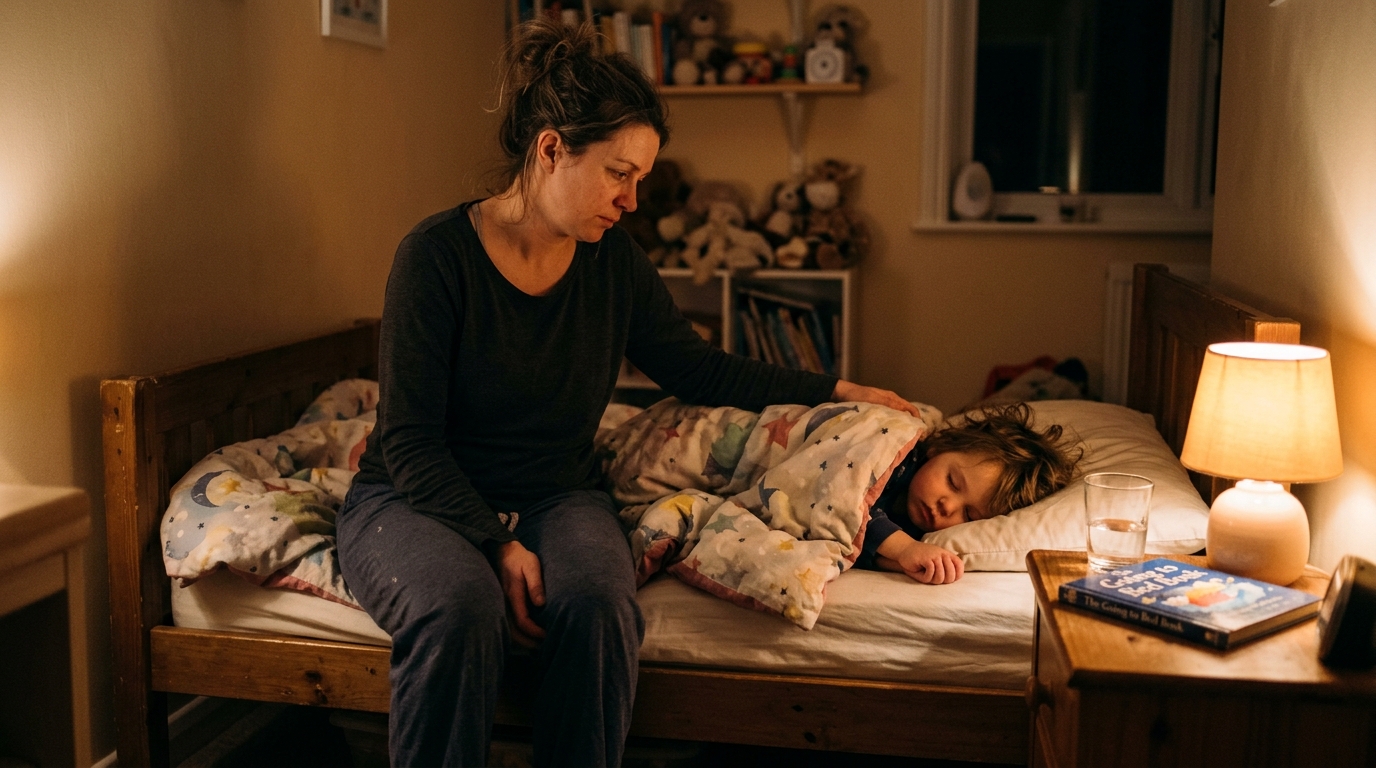
It’s 11.04pm. Your four-year-old has been at the bedroom door seven times. You’ve done the water, the second wee, the “one more cuddle”, the lost teddy, and the mysterious itch on her left foot. You haven’t eaten dinner. Your partner has fallen asleep on the sofa. Tomorrow you have a 9am meeting and she has nursery and neither of you is going to be at your best.
If this is you—and it is a lot of us—you’re not failing. Child sleep problems are one of the most common reasons parents in the UK look for help, and the toll they take on the whole family is real. Bad sleep affects mood, attention, appetite, your relationship, your job, your patience. It doesn’t just affect the child who isn’t sleeping. It affects everyone.
This guide walks through what’s actually going on when your child won’t sleep, what’s developmentally normal, what genuinely helps, and when it’s worth a clinical view. No magic fixes. No shaming. Just what the evidence and a paediatric team actually say.
Sleep needs change a lot with age, and a lot of parental worry comes from comparing a four-year-old’s sleep with a baby’s, or a teenager’s with a ten-year-old’s. NHS guidance gives clear ranges by age[1]:
These are averages, not targets. A child at the lower end of the range who wakes happy, eats well and copes at nursery or school is sleeping enough. A child at the upper end who’s still flat, irritable and falling asleep in the car at 4pm probably isn’t.
The bigger question isn’t usually total hours. It’s the shape of the sleep—how long it takes to fall asleep, how many wakings, how settled the wakings are, and how the child wakes in the morning. A child who takes 90 minutes to fall asleep most nights and wakes three times is exhausted even if you’ve added it up to “nine hours in bed”.
Most child sleep difficulties fall into a few patterns. They overlap, and most children go through more than one.
Settling problems. This is the bedtime-doorstep child. They can’t fall asleep alone. They need you in the room, or lying next to them, or holding their hand. Settling difficulties are extremely common in toddlers and pre-schoolers—it’s a stage, not a character flaw—and they often have an emotional component. Bedtime is separation, and separation is hard.
Night waking. All children wake at night. Adults wake at night. The question is whether they settle back to sleep on their own or whether they need you. Babies who needed feeding to sleep at three months will often need rocking, patting or your presence to fall back asleep at one year, because that’s what they’ve learned sleep is. This is called a sleep association, and it’s the single most common reason for repeated night waking in young children.
Early waking. The 4.47am wake-up. This is often a sign that the child isn’t getting enough deep sleep in the early part of the night, or that they’re going to bed too late and getting overtired, or that their body clock has shifted. Counter-intuitively, an earlier bedtime often helps.
Nightmares. Bad dreams the child remembers, usually in the second half of the night. They’re upsetting, the child wants comfort, and they remember it in the morning. Nightmares are normal from about age 3 onwards and peak between 6 and 10. They get worse when children are stressed, anxious or watching scary content before bed.
Night terrors. Different from nightmares. The child sits up, screams, looks terrified, doesn’t recognise you, can’t be comforted, then falls back asleep with no memory of it. Night terrors usually happen in the first third of the night and peak between ages 3 and 7. They’re frightening to watch but the NHS describes them as a parasomnia that children grow out of[2]. The child isn’t suffering in the way it looks. You are.
Bedtime anxiety. Around one in five children experiences worry at bedtime—about the dark, about death, about burglars, about something happening to you, about a test the next day. Bedtime is when the day gets quiet enough for worries to surface. YoungMinds has practical guidance on managing anxiety in children that applies directly to bedtime worry[3].
A lot of what parents call “sleep problems” is age-appropriate biology, and it gets better with time and consistency. A lot of it doesn’t need a clinician—it needs patience, a predictable routine, and a few small changes.
Genuinely developmental and usually self-resolving:
Worth a closer look when:
You don’t need to wait until it’s “bad enough”. Persistent sleep problems are worth taking seriously—they affect everything else.
There’s a lot of contradictory sleep advice online. Most of it falls apart on contact with a real child. What follows is what the evidence consistently supports, drawn from NHS sleep guidance for children and clinical practice[1].
A predictable bedtime routine. Not a perfect one. A predictable one. The same three or four steps, in the same order, at roughly the same time every night. Bath, pyjamas, two books, lights out. Routine works because a young child’s brain reads sequence as safety—they know what comes next, so the body starts winding down before the lights are off.
A bedtime that matches their biology. Most pre-schoolers need to be asleep by 7–7.30pm. Most primary-age children by 8–9pm. Pushing bedtime later because they’re “not tired” usually backfires—the child gets a second wind, becomes overtired, and takes longer to fall asleep. If your child is bouncing off the walls at 8pm, they probably needed to be in bed at 7.
Screens off an hour before bed. Blue light affects melatonin production, and the content itself—YouTube, TikTok, games—is stimulating. The Royal College of Paediatrics and Child Health has guidance on screen time and sleep that’s worth a read[4]. The hour before bed should be calm, low-light, low-stimulation. Books, drawing, a bath, talking.
Daylight in the morning. Cheap and powerful. Getting outside in natural light within an hour of waking helps set the body clock for the day, which makes evening sleepiness arrive on time.
Gradual retreat for the bedroom-door child. If your child can only fall asleep with you in the room, gradual retreat is one of the most evidence-supported approaches. You sit by their bed for a few nights. Then by the door. Then in the hallway. Then nothing. It takes 2–3 weeks. It’s slow on purpose. The child stays calm because they don’t feel abandoned, but they learn to fall asleep on their own.
Bedtime fade for late-night battles. If your child takes hours to fall asleep, temporarily move bedtime later (yes, later) to the time they’re actually falling asleep. Once they’re falling asleep within 15 minutes, bring bedtime back by 15 minutes every few nights until you’re at the time you want. This works by rebuilding sleep pressure.
Address the worry directly, not the bedtime. If your child’s sleep problem is anxiety, no amount of bedtime tweaking will solve it. You’re solving the wrong problem. Talk about the worry during the day—not in bed at 9pm when everyone’s exhausted. Name it. Normalise it. If it’s persistent or intense, this is where a clinical psychologist can help.
A note on sleep training: there’s a long-standing debate between gentle methods (gradual retreat, bedtime fading, no-cry approaches) and more direct approaches (controlled crying, extinction). The evidence shows that consistency matters more than method. Both approaches work for some families and not others. There’s no shame in either—and a tired parent making a considered choice is a good parent, not a failing one.
Sleep is one of the first things to go when a child is struggling—emotionally, developmentally or physically. If your child’s sleep has changed, it’s worth asking what else is going on.
Anxiety. Bedtime is when worries surface. Children with anxiety often fight bedtime, wake repeatedly, have nightmares, and dread the dark. Our piece on the early signs of anxiety in children covers the wider picture—sleep is often where it first shows up.
ADHD. Children with ADHD are much more likely to have sleep difficulties than their peers[5]. They struggle to wind down, take longer to fall asleep, and often wake unrefreshed. If sleep problems are sitting alongside attention difficulties, impulsivity or restlessness, it’s worth a paediatric or psychiatric view. Our ADHD and autism assessment service covers this.
Autism. Sleep problems are very common in autistic children—estimates from research published in JCPP and elsewhere put it at around 50–80%. Differences in melatonin production, sensory sensitivities, anxiety and routine-dependence all play a part. A multidisciplinary assessment is the right next step if you’re seeing other neurodevelopmental signs.
Allergies and physical health. Cow’s milk allergy, eczema, asthma, reflux, large tonsils or adenoids, and iron deficiency can all disrupt sleep. If your child snores heavily, breathes through their mouth at night, or wakes in pain, a paediatric review is sensible—sleep is downstream of physical health. Our paediatric GP service can help work through this.
Developmental concerns in under-5s. Persistent sleep difficulties in toddlers and pre-schoolers alongside other developmental concerns (language, behaviour, regulation) sometimes warrant a structured developmental assessment. The Anna Freud Centre has useful resources on early childhood mental health for the wider picture[6].
You don’t need to wait until you’re at breaking point. Reasonable triggers for a clinical conversation:
At Kidswell, the right starting point depends on what’s driving the sleep difficulty. Psychology if it’s anxiety or emotional regulation. Paediatrics if it’s physical or developmental. A multidisciplinary view if it’s both—which it often is.
You don’t need a GP referral. You can book an assessment directly. We also offer online and video appointments seven days a week, so you don’t have to take a half-day off work to start the conversation.
Spotting the early signs of anxiety in children—the wider parent guide that pairs with this one when bedtime worry is the real issue.
Kidswell’s psychology service—assessment and therapy for children whose sleep difficulties are tied to anxiety or emotional regulation.
If you’ve read this far at 11.30pm with a child halfway down the stairs, here’s the practical version. Pick one thing to change this week. Move bedtime 15 minutes earlier. Take screens out of the hour before bed. Add one step to the routine and stick to it. Don’t try to fix everything at once—tired parents and tired children can’t sustain a six-point plan.
If you’ve been at this for a month and it isn’t shifting, that’s the moment to ask for a clinical view rather than another sleep blog. Sleep is fixable. It’s also not always something you can fix alone.
Our paediatricians and clinical psychologists at Kidswell Health work together on children’s sleep problems, including those linked to anxiety, ADHD or developmental concerns. You can find out more or book at KidswellHealth.com, or call 020 3011 1843. Same-week appointments are available, and 35% of our consultations now run online or by video.
Kidswell Health is not an emergency or crisis service. If you are worried your child is in immediate danger or seriously unwell:
For non-urgent appointments, contact us at KidswellHealth.com or call 020 3011 1843.

Marielle is a highly experienced Clinical Psychologist and Clinical Lead of the Mental Health Team at Kidswell Health. Marielle brings over 20 years of expertise in supporting children, adolescents, young adults, and families across NHS practices, schools, and private settings.
As an Integrative Psychologist, Marielle tailors her care to each individual’s unique needs, drawing on a range of approaches such as Cognitive Behaviour Therapy, Psychodynamic ideas, Acceptance and Commitment Therapy, EMDR, Mindfulness, and Systemic thinking.
She has a particular interest in early intervention, as well as supporting new parents and helping families navigate fertility challenges. With her compassionate and personalised approach, Marielle is dedicated to helping families through life’s transitions and challenges, ensuring they feel supported every step of the way.
Stubbornness. Defiance. Attention-seeking. Giving in. These are the words that get attached to a child who won’t go to school…

Your son is nine. His best friend sat with someone else at lunch on Tuesday and he came home and…

Your child seems quieter than usual. They won’t eat lunch before school. They’re clinging to you at the classroom door…

If your baby develops a new rash, it can quickly become all you think about. Is it eczema? Heat rash?…

What has happened? There has been an outbreak of meningococcal meningitis in the Canterbury area of Kent. Health authorities have…

Babies do not follow a calendar. They follow their own timetable. It is completely normal for one baby to roll…