

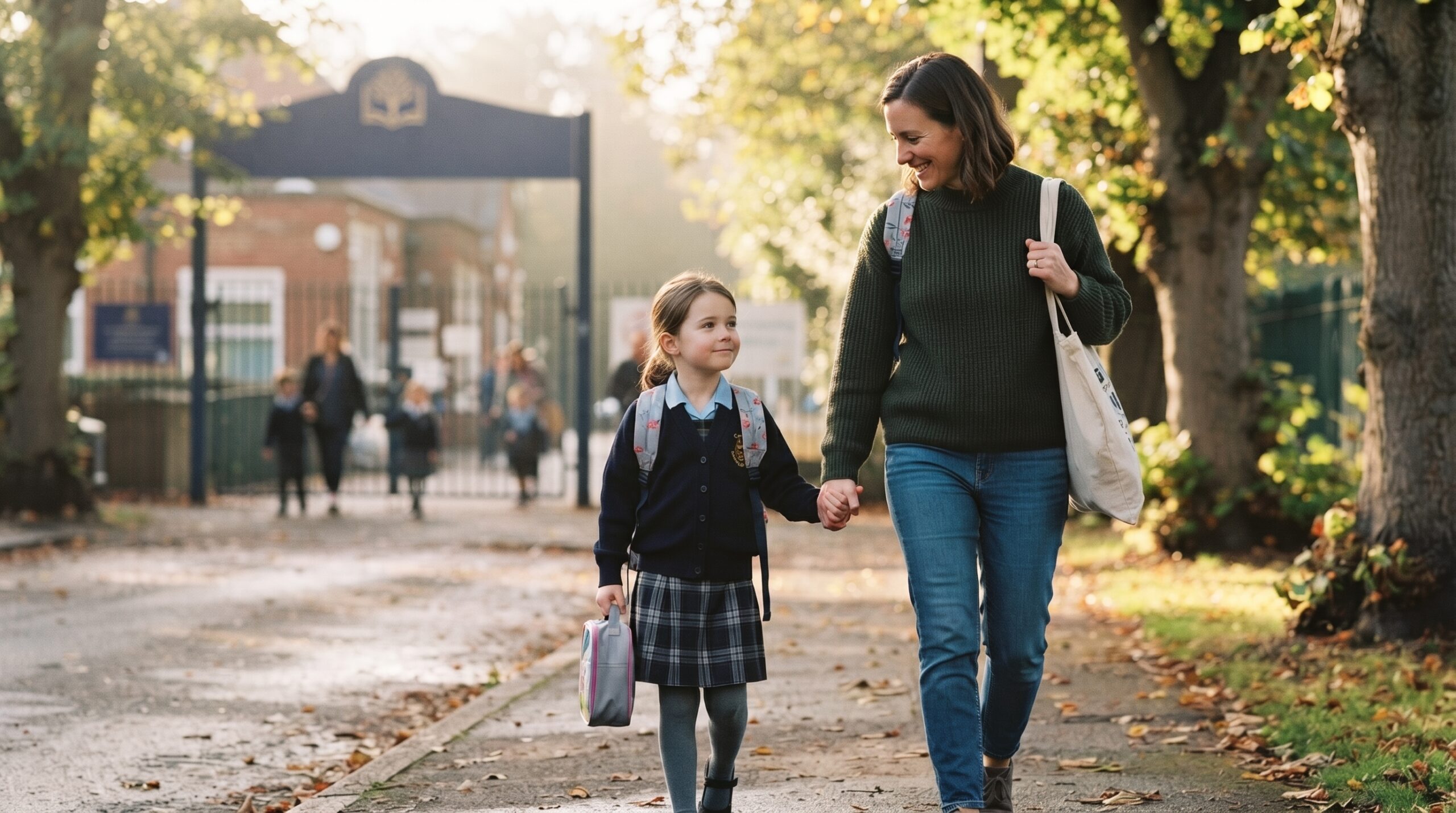
Stubbornness. Defiance. Attention-seeking. Giving in. These are the words that get attached to a child who won’t go to school — by other parents at the gates, by a relative who “would never have got away with it”, and, at 8am on a bad morning, by worn-out parents themselves. Most of them are wrong.
When school refusal repeats morning after morning, the thing underneath is usually anxiety, not misbehaviour. That single reframe changes how you respond to everything that follows: the stomach ache that arrives at 8am and lifts by 10, the tears that come so hard your child can barely breathe, the rigid refusal to get in the car. These look like a behaviour problem. Far more often they are the signs of a nervous system in a panic response — what clinicians call school refusal, and increasingly emotionally based school avoidance.
One in five UK pupils is now persistently absent from school (missing 10% or more of sessions), and emotionally based school avoidance is the fastest-growing reason[1]. This is not a parenting failure. It’s a clinical issue that responds to the right support. This guide will help you understand what’s actually happening, what makes it worse, and what genuinely helps.
First, clarity. School refusal and truancy are not the same thing, and this distinction matters for how you respond.
Truancy is when a child (or parent) chooses not to go to school — they’re avoiding school because they want to be somewhere else, or they simply don’t think it’s important. With truancy, the child isn’t distressed. They’re not panicking. They’re making a choice.
School refusal is different. The child is distressed, often intensely. They want to go to school, or at least they understand they should, but something inside them is screaming danger. They might have a racing heart, difficulty breathing, nausea, or overwhelming dread. They’re not choosing defiance — they’re caught in a panic response[2].
This is called emotionally based school avoidance (EBSA), and clinicians now use this term because it’s more accurate. Your child isn’t being difficult. Their nervous system is overwhelmed.
Refusal means your child becomes distressed at the prospect of attending — not just reluctant, but visibly anxious or panicked. They may have somatic symptoms (physical complaints like stomach pain or headaches). Non-attendance is persistent and not easily resolved by reassurance or incentives.
If your child can’t explain why they’re scared, or their explanations don’t quite match their level of distress, that’s another clue. They might say “I don’t like it” when the real issue is something deeper — social anxiety, perfectionism, separation anxiety, or fear of an undiagnosed learning difficulty they’re trying to hide.
When a child refuses school, anxiety is present in 60–80% of cases[3]. But the anxiety might not look like you expect.
Some children are scared of school itself — of the classroom environment, the noise, the sensory overwhelm, or specific people. Others are fine at school but terrified of the separation from a parent. Some are anxious about social situations or fear being judged by peers. Others are perfectionist and paralysed by the fear of getting something wrong. And some children have undiagnosed neurodevelopmental differences — autism, ADHD, auditory processing issues — that make school feel impossible without support.
The school environment is complex. It’s loud, socially demanding, full of unexpected changes, and built on the assumption that all children can sit still, focus for 20-minute blocks, manage transitions smoothly, and handle group dynamics. If your child’s nervous system or neurodevelopment doesn’t align with that, school becomes a source of constant stress.
Anxiety can also spike after a specific event — a change of teacher, a friendship falling apart, an incident of bullying (even something that seems small to you), or a transition from primary to secondary school. Sometimes there’s no obvious trigger. The anxiety just builds gradually.
Some children with school refusal are primarily anxious about being away from a parent. They worry something bad will happen to the parent, or that they won’t be able to cope without them. This is a form of separation anxiety, and it’s particularly common in children aged 4–8, though it can occur at any age. The anxiety improves only when they’re reunited with the parent — which reinforces the fear.
Other children are fine with the academics but terrified of social situations. They worry about being judged, making mistakes in front of others, or not being liked. Perfectionist children may refuse to do schoolwork if they can’t do it perfectly, or they may be afraid of being “found out” as not being as clever as everyone thinks.
A child with undiagnosed dyslexia, dyscalculia, ADHD, autism, or auditory processing disorder often experiences school as a place where they’re constantly struggling while everyone else seems fine. The shame, the effort it takes to “mask” their difficulties, and the fear of being exposed can all drive school refusal.
School refusal has recognisable patterns. Watch for these signs.
Physical symptoms. Before school, your child complains of stomach aches, headaches, nausea, or dizziness. The symptoms often improve or vanish if the child stays home. They may struggle to eat breakfast on school days. Some children describe chest tightness or difficulty breathing.
Emotional escalation. On school days, your child is tearful, angry, or panicked. The distress is disproportionate to what you’d expect. A comment about a maths test triggers an hour of crying. They might say things like “I can’t do this” or “Everyone hates me” — black-and-white thinking driven by anxiety.
Avoidance and delay. Your child dawdles getting ready. They “lose” their uniform or lunch box. They ask for just one more cuddle, one more story. These aren’t manipulation — they’re anxiety-driven avoidance behaviours. The closer it gets to departure time, the more distressed they become.
Refusal itself. They refuse to get in the car or walk to school. They cling to you. They become rigid, unresponsive, or extremely upset. Some children go mute. Others become almost catatonic. A few run away or hide.
Patterns. The refusal might happen every morning, or it might be episodic (worse on certain days or after weekends). It might have been triggered by an event, or it might have developed gradually. Importantly, it improves when they stay home — which is why avoidance deepens the problem.
This is critical. Well-intentioned parenting strategies often backfire with school refusal. Here’s what actually deepens the anxiety.
Forcing or punishing. If your child refuses school and you forcibly take them, drag them, or use consequences like losing screen time or privileges, you’re teaching their nervous system that school is genuinely a threat. You may get the child into school that day, but you’re priming them to panic harder next time. Punishment increases fear, not compliance[4].
Reassurance loops. You tell your child “You’ll be fine at school” and it helps for five minutes. Then they ask again. You reassure again. And again. This is the reassurance loop. It feels supportive, but it actually teaches your child’s brain that they can’t handle anxiety on their own — they need you to keep fixing it. The reassurance becomes a temporary Band-Aid that keeps the anxiety cycle running.
Dismissing their experience. If you say “You’re being silly” or “Other children manage fine”, you’re adding shame to their anxiety. They’re not being silly. They’re genuinely terrified. Dismissing it makes them less likely to tell you what’s really going on.
Lengthy absences. Every day your child stays home, the anxiety about returning gets worse. The longer the absence, the harder the re-entry. A week off school can spike the anxiety significantly. The goal is to maintain some school attendance, even if it’s part-time at first, to prevent the avoidance from deepening.
Assuming it will resolve on its own. It won’t. School refusal that goes unaddressed typically gets worse, not better. The longer it persists, the harder it is to treat.
This is what works, based on clinical evidence.
Stay calm. Your anxiety fuels theirs. If you’re panicking or angry about the refusal, they feel it and it escalates. You need to be the calm adult in the room. This doesn’t mean force or minimise their fear — it means staying steady and collaborative.
Work with your child, not against them. Ask them what they’re worried about. Listen without immediately trying to fix it. Sometimes just naming the fear — “You’re worried about maths time” or “You’re scared of being alone in the classroom” — is enough to start addressing it. Your child needs to feel you’re on their team.
Keep them going to school, even if it’s part-time. If your child can manage mornings but not full days, do mornings. If they can manage after lunch, start there. The goal is to prevent school avoidance from deepening while you’re getting to the root of the problem. Talk to the school about a phased return or a modified timetable. Good schools understand this and will work with you.
Work with the school. School refusal cannot be resolved by parents alone. The school needs to understand what’s happening and be willing to support your child. This might mean a quieter space to go to if overwhelmed, a familiar adult to check in with, reduced timetable initially, or adjustments for sensory needs. The more the school and home are aligned, the faster your child improves.
Identify the specific trigger if possible. Is the anxiety about separation? Social situations? A particular subject or person? Perfectionism? Sensory overload? Once you know what you’re dealing with, you can address it specifically rather than just trying to “get them back to school.”
Seek a proper assessment. If your child has persistent school refusal or anxiety, a clinical psychologist can conduct a comprehensive assessment. They can identify what’s driving the anxiety, rule out other factors (like learning difficulties or neurodevelopmental differences), and design a treatment plan. Cognitive behavioural therapy (CBT) is evidence-based and effective for school refusal — children who receive CBT show significant improvements in school attendance and anxiety levels[5].
Manage your own anxiety. Your child’s school refusal is stressful. You may feel judged, guilty, or overwhelmed. These feelings are valid. But your child will pick up on them. Consider getting support for yourself — whether that’s talking to a friend, working with a therapist, or joining a parent support group. You can’t regulate your child if you’re dysregulated.
Seek help if your child’s school refusal is persistent (happening more than once a week), if it’s causing significant distress, if it’s affecting their friendships or learning, or if home life is becoming unmanageable because of the morning battles.
You don’t need to wait until things feel “bad enough”. If your child is struggling, that’s reason enough.
A clinical psychologist can assess your child, identify the root cause of the refusal, and offer evidence-based treatment. Early intervention works better. The longer school refusal persists, the harder it becomes to treat.
Spotting the early signs of anxiety in children — a guide to what to watch for
Kidswell’s psychology service — assessment and evidence-based therapy for anxiety and school refusal
Kidswell’s child & adolescent psychiatry service — for complex anxiety and comorbidities
If your child is refusing school, the most important thing to know is this: it’s not a discipline issue, and it’s not a character flaw. It’s a sign they need help managing anxiety. And anxiety responds to the right support.
With proper assessment and treatment, most children with school refusal improve. They learn to manage the anxiety, step back into school, and rebuild confidence. The earlier you act, the faster the improvement.
If you’re concerned about your child’s school attendance or anxiety, our clinical psychologists at Kidswell Health offer specialist assessments and evidence-based therapy. We work with families to identify what’s driving the refusal, develop a plan with the school, and help your child get back to learning. You can find out more or book at KidswellHealth.com, or call 020 3011 1843. Same-week appointments are available, and we offer both in-person and online consultations.
Kidswell Health is not an emergency or crisis service. If you are worried your child is in immediate danger or seriously unwell:
For non-urgent appointments, contact us at KidswellHealth.com or call 020 3011 1843.

Marielle is a highly experienced Clinical Psychologist and Clinical Lead of the Mental Health Team at Kidswell Health. Marielle brings over 20 years of expertise in supporting children, adolescents, young adults, and families across NHS practices, schools, and private settings.
As an Integrative Psychologist, Marielle tailors her care to each individual’s unique needs, drawing on a range of approaches such as Cognitive Behaviour Therapy, Psychodynamic ideas, Acceptance and Commitment Therapy, EMDR, Mindfulness, and Systemic thinking.
She has a particular interest in early intervention, as well as supporting new parents and helping families navigate fertility challenges. With her compassionate and personalised approach, Marielle is dedicated to helping families through life’s transitions and challenges, ensuring they feel supported every step of the way.
It’s 11.04pm. Your four-year-old has been at the bedroom door seven times. You’ve done the water, the second wee, the…

Your son is nine. His best friend sat with someone else at lunch on Tuesday and he came home and…

Your child seems quieter than usual. They won’t eat lunch before school. They’re clinging to you at the classroom door…

If your baby develops a new rash, it can quickly become all you think about. Is it eczema? Heat rash?…

What has happened? There has been an outbreak of meningococcal meningitis in the Canterbury area of Kent. Health authorities have…

Babies do not follow a calendar. They follow their own timetable. It is completely normal for one baby to roll…